Market Analysis & Updates
Dubai Branded Residences in 2026: How Investors Should Read the Latest Surge
Florian
•October 9, 2026
Dubai branded residences have moved from a niche luxury product to one of the most searched property themes in the UAE. The latest signal came in late September 2026, when Knight Frank reported that Dubai remains the world’s largest city market for branded residences, with 175 schemes, including 68 live developments and 107 in the pipeline.
That is not just a prestige headline. It matters for buyers, investors and end-users because branded homes in Dubai often ask for a higher price per square foot than comparable non-branded buildings. The question in 2026 is no longer whether branded residences can attract attention. They can. The better question is whether a specific branded residence in Dubai deserves the premium being charged.
This is a buyer and investor guide to reading the current branded-residence boom with discipline, especially if you are comparing off-plan launches in Downtown Dubai, DIFC, Sheikh Zayed Road, Business Bay, Dubai Harbour, Palm Jumeirah, Jumeirah Bay, Dubai Islands or other prime UAE locations.
Why Dubai Branded Residences Are a Hot Topic Now
The timing is important. On 28 September 2026, Knight Frank’s analysis said the Middle East accounts for 20% of all live and pipeline branded residence schemes globally, while Dubai has already become the world’s largest city market for this category. Khaleej Times, reporting the same study, noted that Dubai’s 175 branded residence schemes put it more than twice the scale of Miami, which had 73 schemes, and far ahead of London, with 30.
Separately, Morgan’s H1 2026 branded residences report described Dubai’s market as entering a more competitive phase. It counted 183 developments and 64,744 branded residential units as of 30 June 2026, with 4,648 transactions worth AED 22.21 billion in the first half. The difference between the 175 and 183 figures reflects different market classifications and timing, but the direction is the same: branded residences are now a major part of Dubai’s luxury property market, not a small sub-segment.
For investors, scale cuts both ways. It confirms deep buyer demand and global developer confidence. It also means more competition between projects. In a crowded market, a famous name on the façade is not enough. The strongest projects will be those where the brand, location, building quality, service model and long-term operations work together.
What Counts as a Branded Residence in Dubai?
A branded residence is usually a privately owned apartment, penthouse, villa or mansion associated with a recognised hotel, hospitality, fashion, design or lifestyle brand. In Dubai, this can include hotel-led brands, ultra-luxury hospitality names, fashion-linked residences, automotive-branded towers and lifestyle-led residential concepts.
The appeal is clear. Buyers may get architecture, interior standards, concierge services, valet, housekeeping options, spa access, private dining, wellness amenities, managed common areas and a sense of exclusivity. Some buyers want the brand for lifestyle. Others see it as a way to protect resale value or rental appeal among executives, high-net-worth tenants and international owners who understand the brand.
However, branded does not automatically mean better investment. A branded home can be excellent, overpriced or poorly matched to its location. A waterfront resort brand may make sense on Palm Jumeirah or Dubai Islands. A business-lifestyle brand may be more convincing near DIFC, One Central or Sheikh Zayed Road. A fashion or automotive brand can work, but only if the design, floor plans, maintenance and resident experience justify the story.
The Emirates Towers Signal: Why Delivery Matters
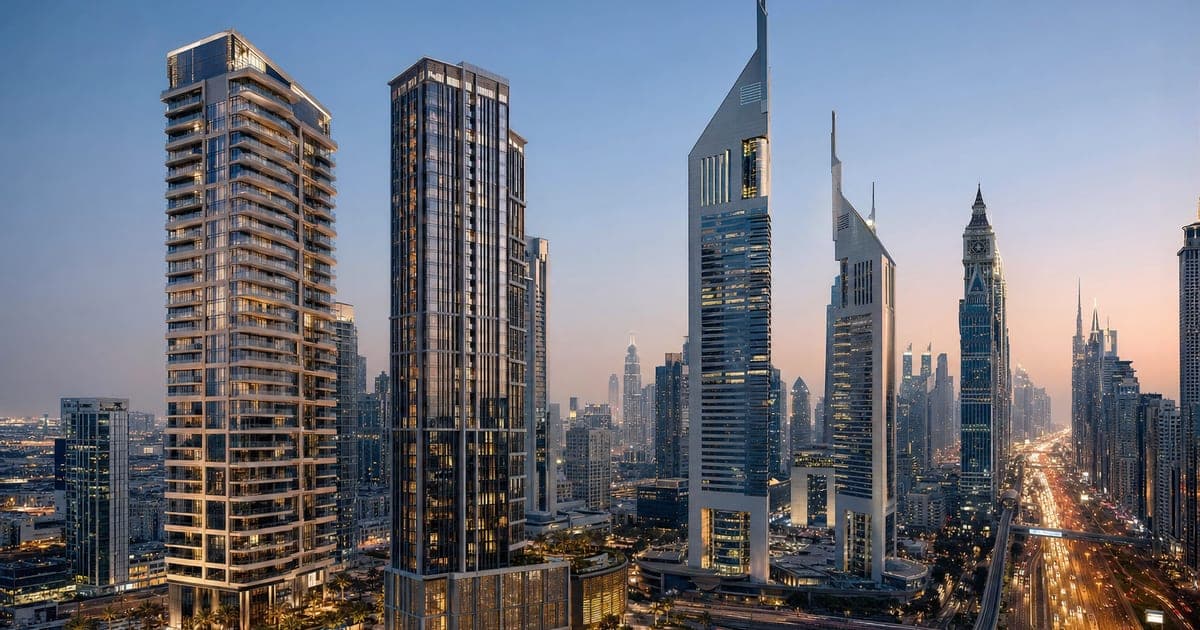
One reason branded residences are back in the news is the AED 5 billion construction contract awarded by Dubai Holding in September 2026 to China State Construction Engineering Corporation Middle East. The contract covers Dubai Holding’s new headquarters and Jumeirah Residences Emirates Towers, with reports stating that the residential component includes 754 branded residences across two towers, expected in 2030.
The project is useful as a market signal, even for buyers who are not considering that specific address. It shows how Dubai’s prime business districts are being repositioned for more residential luxury, not just offices and hotels. Jumeirah Residences Emirates Towers is positioned near Sheikh Zayed Road, DIFC, Museum of the Future, One Central, Downtown Dubai and City Walk. The official project page describes one- to four-bedroom apartments, sky pools, concierge, valet, security and à la carte services such as housekeeping, spa treatments and private dining.
For off-plan buyers, the key takeaway is not simply that the project is high-profile. It is that construction progress, contractor appointment, escrow discipline and handover timing matter. In a market where many branded projects are under construction, investors should not buy only the brochure. They should verify the developer, the land status, the escrow account, payment schedule, construction milestones, service model and expected completion date.
How to Assess the Premium Before You Buy
Morgan’s reported that Dubai branded residences achieved an average price of AED 3,662 per square foot in H1 2026 and a 56% premium over comparable non-branded residences. That premium is the centre of the investment decision. Paying more can be rational if the asset has scarcity, superior location, better operations and stronger end-user demand. Paying more just because the launch is fashionable can weaken future returns.
Before reserving a unit, compare the branded project against non-branded alternatives in the same district. Do not compare a Sheikh Zayed Road branded residence with a standard apartment in a completely different community and assume the gap is justified. Benchmark against nearby ready stock, comparable off-plan projects, service charges, floor height, views, parking, unit efficiency, building density and realistic resale liquidity.
Practical checks include:
- Price per square foot: compare the project with similar buildings in the same micro-location, not with Dubai averages.
- Service charges: branded services can improve lifestyle, but high recurring costs can reduce net yield.
- Brand agreement: ask how long the brand relationship lasts and what happens if the operator changes.
- Rental audience: identify whether the likely tenant is an executive, family, holiday-home guest, corporate tenant or owner-occupier.
- Exit liquidity: check whether future buyers will value the brand, view, layout and address enough to pay a resale premium.
- Delivery risk: review construction stage, contractor, payment plan and handover assumptions before committing capital.
Where Branded Residences Make the Most Sense in Dubai
The strongest branded-residence locations in Dubai usually have one of three advantages: global recognition, genuine scarcity or a clear resident use case. Palm Jumeirah, Jumeirah Bay and Dubai Harbour benefit from waterfront scarcity and luxury lifestyle demand. Downtown Dubai and DIFC benefit from global business, tourism, dining and proximity to Dubai Mall, Burj Khalifa and corporate headquarters. Sheikh Zayed Road and Emirates Towers benefit from centrality and executive demand. Dubai Islands may appeal to buyers looking for future beachfront supply, but investors should be more careful about delivery timelines and future competition.
For end-users, the best choice depends on daily life. A buyer relocating to Dubai for work near DIFC may value a serviced urban residence more than a resort-style address. A family may prioritise schools, traffic, bedroom sizes and storage over a brand name. An investor targeting short-term rentals should check building rules, licensing requirements and realistic occupancy, rather than assuming that a luxury brand automatically creates high net income.
For long-term investors, branded residences should be treated like a specialist asset class. The best units are often those with defensible views, efficient layouts, limited comparable supply and a brand that genuinely improves the resident experience. The weakest units are usually those where the buyer pays a premium but receives a compromised layout, average view, high service charges and limited differentiation from nearby non-branded stock.
Caveats for 2026 Buyers and Investors
Dubai’s branded-residence market is strong, but it is also becoming more selective. Knight Frank’s latest analysis noted that buyers are increasingly looking beyond the name on the building and focusing on the home, location and service offering. That matches what serious investors should do in 2026.
Be especially careful with assumptions around capital appreciation. A branded project can perform well, but there is no legal or market guarantee that it will outperform. If a district receives several similar branded launches at once, scarcity may be weaker than the marketing suggests. If service charges are materially higher than competing buildings, net yield can disappoint. If the handover is years away, the buyer carries construction, financing, resale and market-cycle risk.
Also remember that some branded homes are bought primarily for lifestyle, not yield. That is perfectly valid, but the strategy should be honest. A trophy apartment near DIFC, Downtown Dubai or Palm Jumeirah may be a strong personal-use asset even if its rental yield is modest. A pure investor should be stricter on entry price, payment plan, expected rent, holding costs and resale depth.
Conclusion: Buy the Asset, Not Just the Brand
Dubai branded residences are one of the clearest luxury property themes of 2026. The market has scale, global demand and strong developer momentum. But as supply expands, the winning projects will be separated by location quality, delivery confidence, service execution and sensible pricing.
For buyers, the smart move is to underwrite each branded residence like a real asset, not a logo. Compare the micro-location, service charges, floor plan, view, handover risk and likely exit buyer before paying the premium. BrokeryHero helps clients approach Dubai property decisions with that kind of practical, evidence-led thinking, whether the goal is lifestyle, rental income or long-term capital preservation.
Sources
- From established markets to emerging destinations: the Middle East’s branded residence evolution
- Dubai remains world’s branded residence capital as UAE accounts for 19% of global market
- Dubai Branded Residences Report H1 2026
- Dubai Holding to construct Dh5 billion headquarters near Emirates Towers
- Jumeirah Residences Emirates Towers
Stay in the loop
Get the latest articles delivered every week.
By subscribing, you agree to receive blog updates. Unsubscribe anytime.
More from this category
Oct 7, 2026
Oct 5, 2026
Oct 2, 2026

Sep 30, 2026
Sep 28, 2026
Sep 25, 2026
Sep 23, 2026
Sep 21, 2026
Sep 18, 2026