Market Analysis & Updates
Dubai Metro Gold Line: What the 2026 Announcement Means for Property Buyers and Investors
Florian
•May 18, 2026
Dubai’s newest property catalyst is not another tower launch. It is a transport announcement with the potential to change how people live, commute and value homes across several of Dubai’s most active residential corridors.
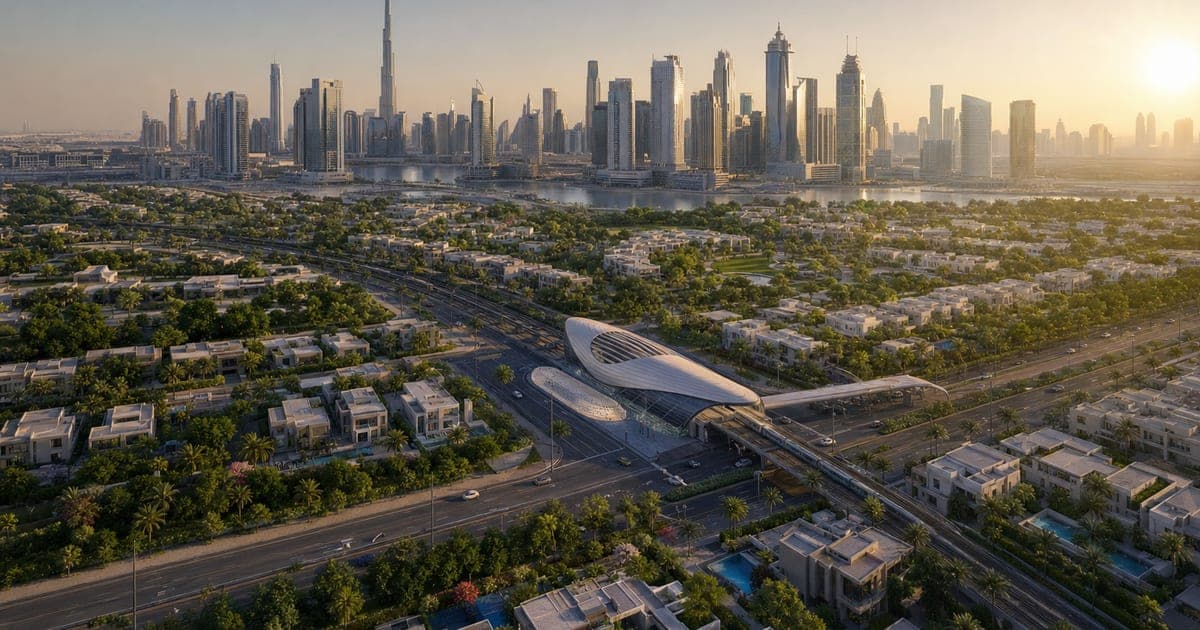
On 22 April 2026, Dubai approved the Dubai Metro Gold Line, a 42 km, 18-station underground metro project with an estimated AED 34 billion investment and a target opening date of 9 September 2032. The line is planned to connect historic Dubai with major growth districts including Mina Rashid, City Walk, Business Bay, Mohammed Bin Rashid City, Nad Al Sheba, Meydan, Al Barsha South, Jumeirah Village Circle and Jumeirah Golf Estates.
For Dubai property buyers and investors, the question is not simply whether prices near the Gold Line will rise. The smarter question is: which communities actually gain usable connectivity, which ones already price in the story, and where could investors overpay before the benefit is delivered?
Why the Dubai Metro Gold Line matters for real estate
The Gold Line is important because it targets a real weakness in Dubai’s property map: many high-demand communities are still heavily car-dependent. Areas such as Dubai Hills Estate, Meydan, Al Barsha South, JVC and parts of the wider Jumeirah Golf Estates corridor have strong residential appeal, but daily mobility often relies on cars, taxis, school runs and access to main roads.
The official announcement says the Gold Line will connect with the Red Line at Business Bay and Jumeirah Golf Estates, with the Green Line at Al Ghubaiba, and with Etihad Rail at Meydan and Jumeirah Golf Estates. That is a major shift. It is not only about reaching Downtown Dubai faster. It is about connecting residential communities, job centres, old Dubai, future national rail and major mixed-use developments into one network.
Dubai authorities also said the line is expected to serve more than 55 development projects and benefit over 1.5 million people by 2040. RTA leadership has linked infrastructure near metro stations to potential property value uplift of up to 20%, but buyers should treat that as a broad infrastructure effect, not a guaranteed return on any specific building or unit.
Which Dubai communities could see the clearest property impact?
The most obvious winners are communities where metro access changes the everyday use case, not just the marketing brochure. A station within a practical walking distance can affect tenant demand, resale liquidity and household car costs. A station that is technically nearby but difficult to reach across highways may have a weaker effect.
Here are the Gold Line-linked areas worth watching closely:
- Business Bay: Already connected to the Red Line, but the Gold Line could strengthen Business Bay’s role as a multi-line interchange close to Downtown Dubai, DIFC access routes and the Dubai Canal.
- Meydan: A major long-term beneficiary if the planned Etihad Rail connection is delivered as announced. This could support both residential demand and mixed-use investment around future mobility nodes.
- Dubai Hills Estate: A premium family community where metro access would reduce one of the main lifestyle objections: car dependence. Villas and larger apartments may benefit from stronger end-user demand.
- Al Barsha South: This area sits between established schools, healthcare, villas, apartments and arterial roads. Better rail access could improve rental appeal for families and professionals.
- Jumeirah Village Circle: JVC already has deep rental demand and a large apartment pipeline. Metro access may help absorption, but investors must be selective because supply is also significant.
- Jumeirah Golf Estates: The planned connection to both the Red Line and Etihad Rail could improve access for a community that has traditionally appealed to car-owning residents.
- Mina Rashid and Al Ghubaiba: These locations may benefit from improved linkage between old Dubai, waterfront redevelopment and the wider metro network.
The biggest practical caveat: final station names, entrances and exact walkability zones are not fully public yet. Do not buy a property based only on a route graphic. For investment decisions, a few hundred metres, a highway crossing or a missing pedestrian link can change the result.
How the Gold Line fits into Dubai’s 2026 property market
The timing matters. Dubai’s residential market entered 2026 with strong activity, but also with more nuance than the record-breaking headlines suggest. REIDIN reported AED 137.3 billion in Dubai residential sales across 45,221 transactions in Q1 2026, with off-plan sales accounting for AED 103.4 billion of that value.
Emirates NBD Research noted that more than 45,200 property transfers were recorded in Q1 2026, up 4% year on year, even though March activity slowed after a strong January and February. Knight Frank also reported AED 137.3 billion in Q1 sales value and said off-plan accounted for 72% of transactions during the quarter.
That combination is important for Gold Line investors. Dubai still has strong demand, but it is not a market where every off-plan launch should be treated the same. Transport-led narratives can attract aggressive pricing, especially in areas where developers quickly reframe projects as metro-proximity plays.
In other words, the Gold Line is a strong long-term signal, but it should not replace the basics: entry price, payment plan, service charges, handover timeline, developer track record, floor plan efficiency, view protection and realistic rent assumptions.
Buyer strategy: how to avoid paying for hype
If you are buying to live in the property, the Gold Line can improve quality of life, but the benefit is delayed. The opening target is 2032, so a buyer in 2026 is making a six-year lifestyle bet. That can make sense if the community already works for your family today and the metro is future upside, not the only reason to buy.
If you are buying as an investor, be more disciplined. A transport announcement can create two different price movements: an early sentiment premium and a later usability premium. The early premium happens when everyone starts talking about the line. The usability premium arrives only when stations, access points and commuting patterns become real.
Before committing, check:
- Actual distance to the likely station zone: Five minutes by car is not the same as five minutes on foot in Dubai summer.
- Competing supply: JVC, Meydan and parts of Dubailand have large development pipelines. Metro access helps, but oversupply can still pressure rents.
- Unit type: Studios and one-bedrooms may attract commuters, while family-sized units need schools, parks, parking and community amenities as much as rail access.
- Developer pricing: Compare launch prices with recent DLD transactions in the same district, not only with future marketing claims.
- Exit timing: If you plan to resell before 2032, your buyer is still buying the promise, not the completed infrastructure.
Renters and relocators: what changes before 2032?
For renters moving to Dubai in 2026 or 2027, the Gold Line should not dominate your immediate housing decision unless you have a long-term plan to stay in the same community. The line is not open yet. Today’s commute, school route and road access still matter more than a future station.
However, relocators who are deciding between renting and buying should pay attention. If you already like communities such as Dubai Hills, JVC, Al Barsha South or Meydan, future metro access may improve resale liquidity over a longer holding period. It may also support rental depth, especially among professionals who want to reduce reliance on cars.
For landlords, the best move is not to raise expectations overnight. It is to protect the long-term rentability of the asset: choose efficient layouts, maintain the property well, price competitively and monitor confirmed station updates as RTA releases more detail.
Practical caveats before you buy near the Gold Line
The Gold Line is a major infrastructure project, but it is still early. Tendering, contract awards, tunnelling, station design, pedestrian access and surrounding road upgrades all matter. Dubai has a strong delivery record on major infrastructure, yet investors should still build timing risk into the deal.
Also remember that not every property near a metro line becomes a winner. Buildings with high service charges, poor maintenance, weak layouts or too much similar supply can underperform even in a better-connected district. Conversely, a slightly less obvious building with strong management, practical parking, good views and fair entry pricing may outperform a heavily promoted project with a metro story baked into the price.
The most balanced strategy is to treat the Dubai Metro Gold Line as a filter, not a final answer. Use it to shortlist districts. Then underwrite the individual property like any serious Dubai investment.
Conclusion: a real catalyst, but not a shortcut
The Dubai Metro Gold Line is one of the most important real estate-adjacent announcements of 2026 because it directly targets mobility in growth communities that already matter to buyers, tenants and developers. Business Bay, Meydan, Dubai Hills Estate, Al Barsha South, JVC and Jumeirah Golf Estates all deserve closer attention as the route develops.
But the opportunity is not simply buying anything near the proposed line. The winners will be properties where future connectivity combines with fair pricing, strong livability, manageable supply and a realistic holding period. BrokeryHero’s view is simple: follow the infrastructure, but buy the fundamentals.
Sources
- Mohammed bin Rashid approves Dubai Metro’s Gold Line spanning 42 km, 18 stations
- Dubai Residential Real Estate Q1 2026 Market Overview – REIDIN
- Dubai Residential Review - Q1 2026 | Emirates NBD Research
- Dubai Residential Market Review - Q1 2026 | Knight Frank
- The Dubai Metro Gold Line: All the details you need to know - What’s On
Stay in the loop
Get the latest articles delivered every week.
By subscribing, you agree to receive blog updates. Unsubscribe anytime.
More from this category
Sep 9, 2026
Sep 7, 2026
Sep 4, 2026
Sep 2, 2026
Aug 31, 2026
Aug 28, 2026
Aug 17, 2026

Aug 14, 2026
Aug 12, 2026
Aug 10, 2026