
Market Analysis & Updates
Abu Dhabi’s 0% Rent Freeze: What Dubai Renters and Investors Should Watch Next
Florian
•July 6, 2026
Search intent: regulation update and investor insight for Dubai renters, landlords and property buyers.
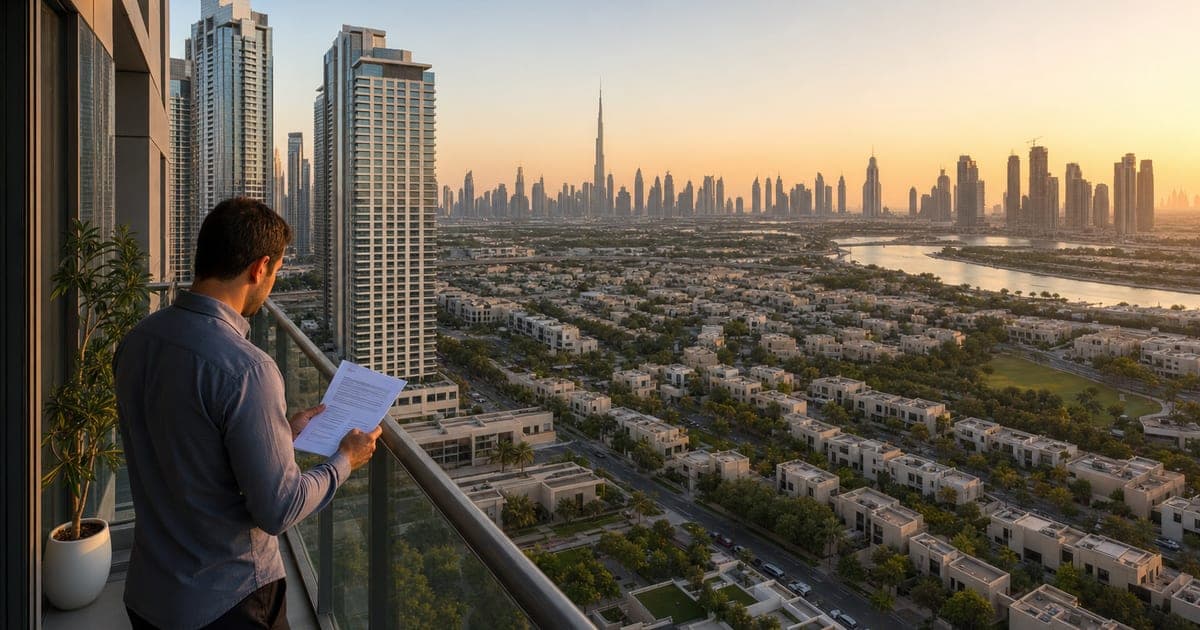
Abu Dhabi’s June 2026 rent freeze is one of the most important UAE housing policy moves of the year. On 3 June 2026, the Abu Dhabi Real Estate Centre confirmed a temporary update reducing the annual rental increase percentage from 5% to 0% for residential, commercial and industrial properties across the emirate. The measure applies until further notice, with renewals and new agreements referencing the last registered Tawtheeq rent.
For Dubai, the immediate takeaway is not that the same rule has arrived. It has not. Dubai continues to operate under its own rental framework, with rent increases checked through the Dubai Land Department Rental Index service and the Dubai REST ecosystem. But the Abu Dhabi move matters because Dubai tenants are already sensitive to renewal increases, landlords are watching yields closely, and investors are trying to judge whether rental income assumptions still hold in a more regulated, more mature market.
Here is what Dubai renters, buyers and landlords should take from the Abu Dhabi rent freeze, without overreacting or assuming a Dubai-wide freeze is inevitable.
What Abu Dhabi Actually Changed in June 2026
The Abu Dhabi measure is a temporary 0% cap on annual rental increases. ADREC said the update covers residential, commercial and industrial properties and is designed to create more predictability for households and businesses after several years of strong demand, high occupancy and rising new lease prices.
The key detail for Dubai readers is that Abu Dhabi’s system is separate from Dubai’s. Abu Dhabi uses Tawtheeq contract registration, while Dubai uses Ejari and the DLD/RERA rental framework. A policy announcement in Abu Dhabi does not automatically change what your Dubai landlord can charge, what your Dubai tenant can challenge, or what an investor can assume for a Dubai buy-to-let property.
Still, the decision is useful market intelligence. It shows that UAE housing affordability is now a live policy priority, not just a tenant complaint on social media. It also shows that regulators may intervene when rapid rent growth starts to affect residential stability and business continuity. For Dubai property investors, that means rental growth should be stress-tested, not simply extrapolated from the last two years.
Dubai Has Not Announced a 0% Rent Freeze
As of 6 July 2026, Dubai has not announced an Abu Dhabi-style blanket 0% rent freeze. Dubai’s current route is more targeted: the official DLD Rental Index service allows users to calculate the rental increase and average rental value in the market by entering the relevant area and property details.
That distinction matters. A blanket freeze stops rent increases across a broad category for the period of the measure. Dubai’s index-based system is more property-specific. In some cases, a tenant may see no permitted increase because the current rent is already close to the index range. In other cases, an increase may be allowed if the current rent is meaningfully below the benchmark.
Dubai also appears to be tackling rental pressure through payment flexibility rather than only price controls. On 23 June 2026, Dubai Land Department launched the Flexi Rent initiative with several real estate partners. The initiative focuses on broadening tenant options through payment plans such as monthly, quarterly and semi-annual instalments, along with possible incentives, discounts or promotional packages based on partner policies.
For renters, the practical message is simple: do not accept a renewal increase just because it sounds normal. Check the official DLD Rental Index, verify your Ejari details, and keep written records of any notice or negotiation. For landlords, the message is equally practical: rent strategy now needs to be compliant, documented and realistic, especially if vacancy risk is rising in your building or community.
Why This Matters for Dubai Tenants Renewing in 2026
Dubai tenants should treat the Abu Dhabi freeze as a reminder to become more disciplined at renewal. It is not a legal argument by itself in Dubai, but it strengthens the wider conversation around affordability, transparency and fair rental practices.
Before agreeing to a new rent, tenants should check three things:
- The official rental benchmark: Use the Dubai Land Department Rental Index service or Dubai REST app rather than relying only on listings, agent comments or building rumours.
- The renewal timeline: Keep track of when your lease expires and when any rent change was communicated. Late or informal discussions can create avoidable disputes.
- The real replacement cost: Compare not only annual rent, but moving cost, deposits, agency fees, school runs, commute time, parking and chiller arrangements.
This is especially important in popular tenant-heavy areas such as Jumeirah Village Circle, Dubai Marina, Business Bay, Dubai Hills Estate, Arjan, Town Square, Dubai Silicon Oasis and Dubai South. In these communities, the advertised market can move faster than a sitting tenant’s actual renewal position. A landlord may point to high listing prices, while the tenant’s legal renewal position may depend on the index and contract history.
If you are relocating to Dubai in 2026, the lesson is different. You do not have the protection of an existing Ejari renewal history yet, so you are exposed to current asking rents. In that case, negotiate payment terms, maintenance obligations, chiller terms, parking, early termination clauses and renewal expectations before signing. A slightly higher rent with clearer terms can be safer than a cheaper unit with vague conditions.
What Investors Should Stress-Test Before Buying for Rental Yield
For Dubai property investors, the Abu Dhabi rent freeze is not a reason to exit the market. It is a reason to underwrite more carefully. Dubai residential demand remains deep, with recent H1 2026 reporting pointing to very large transaction value across the first half of the year. But a mature market is not the same as a one-way market. Regulation, supply, tenant affordability and financing costs all influence net returns.
When reviewing a Dubai apartment, townhouse or villa for investment, avoid basing the deal only on the highest advertised rent in the building. Instead, ask for a conservative rent range and test your return under three scenarios: current achievable rent, a flat renewal year, and a softer rent year. If the investment only works with annual increases, it may be too fragile.
Investors should also separate gross yield from net usable income. Service charges, maintenance, vacancy periods, leasing fees, property management, mortgage interest and furnishing replacement can materially reduce returns. This is particularly important in high-amenity apartment towers, branded residences, waterfront buildings and short-term rental units where operating costs can be higher.
Communities with strong end-user demand are likely to remain more defensive than purely speculative stock. Look closely at schools, metro or road access, supermarkets, building maintenance, unit layouts, parking ratios and handover quality. A well-managed two-bedroom apartment near daily amenities can outperform a more dramatic-looking unit in a building with weak service quality and high tenant churn.
Where the Dubai Opportunity Could Shift
If rental regulation becomes a bigger theme across the UAE, Dubai investors may become more selective about where income growth can realistically come from. The opportunity is less about chasing the fastest headline rent increase and more about owning property that tenants want to stay in.
That could support demand for family-ready villas and townhouses in established communities, practical mid-market apartments near transport and employment hubs, and buildings with reliable maintenance. Areas such as Dubai Hills Estate, JVC, Town Square, Dubai South, Dubai Creek Harbour, Business Bay, JLT, Arjan and Dubai Marina each have different tenant profiles, so the right choice depends on budget, holding period and risk tolerance.
For buyers deciding whether to rent or buy, the Abu Dhabi freeze also raises a useful question: do you want housing cost flexibility or housing cost control? Renting can be more flexible, especially for newcomers testing Dubai neighborhoods. Buying can create longer-term stability if you plan to stay, have enough upfront cash, and choose a property with strong resale and rental fundamentals.
Do not buy only because you fear future rent hikes. Buy because the numbers work, the location suits your life, and the property remains attractive even if rents flatten for a period.
Practical Checklist Before You Act
- Tenants: Check the DLD Rental Index before accepting any Dubai renewal increase.
- New renters: Compare total occupancy cost, not just annual rent.
- Landlords: Keep renewal notices, index checks and tenant communications documented.
- Investors: Model at least one year of flat rent before buying.
- Buyers: Prioritise communities with real tenant demand, not only launch hype.
- Relocators: Rent first if you are unsure about commute, school catchment or lifestyle fit.
Conclusion: Watch the Signal, Not the Noise
Abu Dhabi’s 0% rent freeze is not a Dubai rent freeze. But it is a timely signal that housing affordability, rental transparency and tenant stability are now central to UAE real estate policy. Dubai’s current approach remains different, with the DLD Rental Index and newer initiatives such as Flexi Rent shaping how tenants and landlords manage renewals and payments.
For Dubai renters, the best move is to verify before agreeing. For landlords, it is to price responsibly and protect occupancy. For investors, it is to buy assets that still make sense if rent growth slows. BrokeryHero helps clients read these signals clearly, compare communities realistically and make Dubai property decisions based on evidence rather than market noise.
Sources
- Temporary update to Annual Rental Cap Increase in Abu Dhabi
- Dubai Land Department - Rental Index
- Dubai Land Department Launches Flexi Rent Initiative and Strengthens Strategic Partnerships to Advance Rental Market Accessibility
- Dubai Home Sales Hit Dh221.3 Billion in H1 2026 as June Rebound and Off-Plan Deals Signal Strong Investor Demand
- CBUAE Quarterly Economic Review June 2026
Stay in the loop
Get the latest articles delivered every week.
By subscribing, you agree to receive blog updates. Unsubscribe anytime.
More from this category
Sep 9, 2026

Sep 7, 2026
Sep 4, 2026
Sep 2, 2026

Aug 31, 2026
Aug 28, 2026

Aug 17, 2026

Aug 14, 2026
Aug 12, 2026
Aug 10, 2026