Dubai Properties
Dubai Hills Build-to-Rent: What Brookfield-Alshaya’s 2026 Project Means for Buyers
Florian
•June 19, 2026
Dubai Hills Estate has been on buyer shortlists for years, but a new May 2026 announcement gives the community a different kind of signal: institutional build-to-rent demand. On 7 May 2026, Brookfield and Alshaya Group announced a joint venture to develop a 480,000 sq ft mixed-use asset in the heart of Dubai Hills, featuring Grade A office space, retail and build-to-rent residences.
For Dubai property buyers, this is not just another off-plan launch. It is a reminder that Dubai Hills is maturing from a residential master community into a deeper live-work-retail district. That changes how investors should think about tenant demand, resale appeal, rental competition and the kind of apartments that may hold value as the wider Dubai market becomes more selective.
Why this Dubai Hills announcement matters now
The project is timely because it lands in a market that is no longer moving in one straight line. CBRE’s Q1 2026 UAE real estate review described Dubai’s residential sector as entering a period of potential recalibration after recent record transaction volumes. At the same time, Dubai’s office market remained tight, with average office rents up 14% year-on-year, prime office rents up 16% and average occupancy at 95% in Q1 2026.
That office backdrop matters for Dubai Hills. Brookfield and Alshaya’s project is not a standalone residential tower chasing investors with a payment plan. It is a mixed-use employment, retail and rental-residential node. Alshaya has also said it will establish its new UAE office on the premises, with retail space showcasing some of its brands.
In practical terms, this adds an occupier-led anchor to Dubai Hills Estate. For end-users, that can strengthen the daily-life proposition. For landlords, it may widen the tenant pool to include professionals who want to live near work, Dubai Hills Mall, King’s College Hospital Dubai, Dubai Hills Golf Club and established residential clusters.
Build-to-rent is different from ordinary off-plan apartments
Dubai buyers should understand the phrase build-to-rent. In a conventional off-plan project, units are sold individually to buyers, who may occupy, resell or lease them. Build-to-rent usually means the residential component is designed and operated for long-term rental income, often under single or institutional ownership. The Brookfield-Alshaya announcement identifies build-to-rent residences, but it does not publicly provide unit numbers, rent levels, delivery dates or whether any residential component will be sold individually.
That distinction matters. If the residential portion is retained for rental operation, investors may not be able to buy directly into that specific stock. Instead, the opportunity is indirect: owning nearby apartments or townhouses that benefit from stronger community infrastructure, more footfall and a broader employment base.
It also introduces a caveat. Professionally managed rental buildings can be attractive to tenants because they may offer predictable maintenance, amenities and leasing standards. Nearby individual landlords should not assume automatic rent growth. They may need to compete on condition, furnishing quality, parking, views, building management and realistic pricing.
What it could mean for Dubai Hills buyers and investors
Dubai Hills already attracts families, healthcare professionals, executives, golf-community buyers and tenants seeking a central but less dense alternative to Downtown Dubai or Dubai Marina. A high-quality mixed-use asset can deepen that appeal, but investors should be precise rather than emotional.
Here is how to read the signal:
- For apartment investors: focus on buildings with strong handover quality, efficient layouts, easy access to Dubai Hills Mall and credible service-charge history. If more professionally managed rental stock enters the community, weaker units may face more pressure.
- For end-user buyers: the project supports the live-work-play story of Dubai Hills. But do not pay a premium only because of a headline. Compare actual walking distances, traffic access, school routes, hospital proximity and noise exposure.
- For landlords: expect tenants to compare your unit against newer rental options. Good furnishing, responsive maintenance and transparent renewal terms can become a real advantage.
- For villa and townhouse owners: the impact is more about community maturity and convenience than direct rental competition, since build-to-rent apartments typically serve a different tenant profile.
- For short-term flippers: be careful. A maturing Dubai market rewards specific assets, not generic exposure to a popular community.
The key point is that the project strengthens Dubai Hills as a mixed-use district, but it does not remove the need for disciplined entry pricing. In a market where more supply is coming, asset selection matters more than ever.
How this fits Dubai’s wider live-work-play direction
The Brookfield-Alshaya project also aligns with Dubai’s broader planning direction. The Dubai 2040 Urban Master Plan emphasizes integrated service centres, better access to daily needs and improved quality of life. Dubai’s 20-minute city concept focuses on making essential destinations reachable within shorter daily travel windows through walking, cycling and transport connectivity.
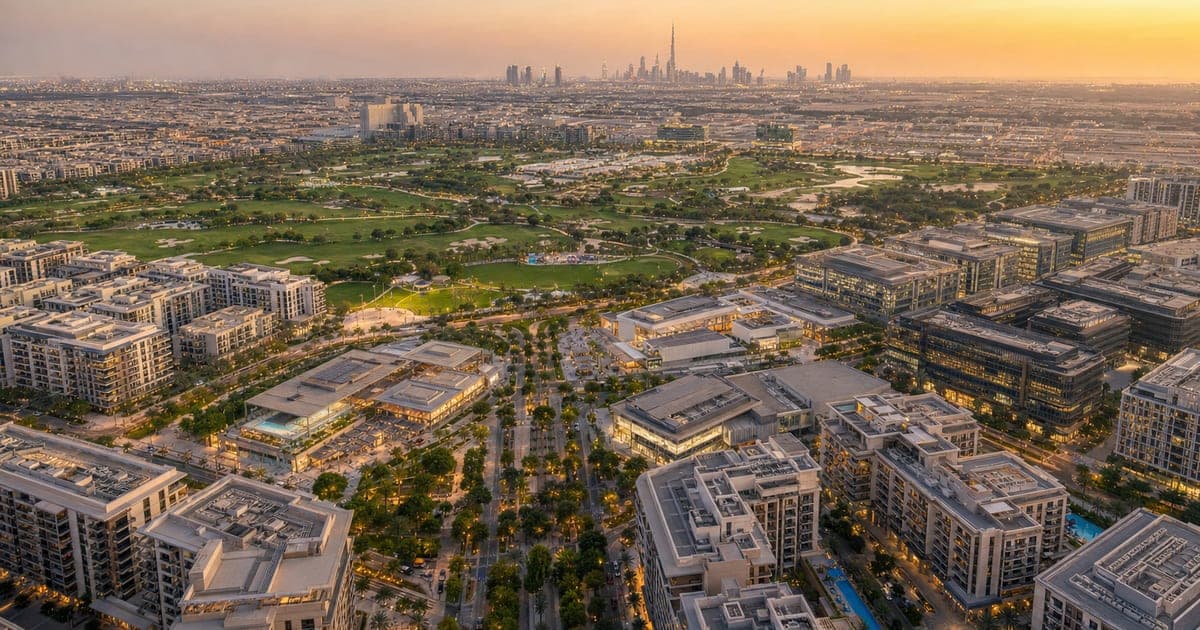
Dubai Hills is already one of the clearest examples of that direction: residential clusters, a major mall, hospital, park space, golf, schools nearby and road access toward Al Khail Road and Umm Suqeim Street. The new mixed-use project adds office and retail depth to that equation.
For property decisions, this is important because Dubai’s next phase is not only about skyline growth. It is about communities that can retain residents through life changes: single professionals becoming couples, families needing schools and healthcare, executives wanting shorter commutes, and long-term tenants prioritising convenience over pure rent discounts.
That does not mean every Dubai Hills property is automatically a strong investment. It means the community’s fundamentals are becoming more layered. Investors should look for assets that benefit from that layering without being exposed to avoidable drawbacks such as poor building management, awkward access, high service charges or excessive purchase premiums.
What to check before buying in Dubai Hills in 2026
If you are considering Dubai Hills apartments, villas or townhouses in 2026, use this announcement as a due-diligence trigger, not a reason to rush. Ask more detailed questions before you sign a booking form or make an offer.
- Check comparable transactions: look at recent sold prices in the same building or sub-community, not only asking prices on portals.
- Separate ready from off-plan: ready units can show real rent, service charges and building quality; off-plan requires stronger assumptions.
- Review rental evidence: compare new lease levels and renewal levels where possible, because asking rents may not reflect achieved rents.
- Study the micro-location: proximity to the mall, park, hospital and main roads can affect both tenant demand and daily convenience.
- Stress-test your yield: include service charges, vacancy, maintenance, furnishing, mortgage costs and realistic rent growth.
- Watch future supply: new rental stock can improve the community, but it can also raise tenant expectations and increase competition for average units.
For investors, the strongest strategy may be to target quality over the lowest ticket size. A well-managed one- or two-bedroom apartment with practical layout and strong access can outperform a cheaper unit in a weak building. For families, the better decision may be a townhouse or villa if school runs, storage, parking and long-term lifestyle matter more than headline yield.
The practical BrokeryHero view
Brookfield and Alshaya’s Dubai Hills project is a meaningful 2026 signal because it combines three demand drivers: Grade A offices, build-to-rent residences and branded retail. It supports the idea that Dubai Hills Estate is becoming a more complete mixed-use district, not only a residential address.
But smart buyers should avoid turning one announcement into a blanket investment thesis. The right question is not, “Should I buy in Dubai Hills?” The better question is, “Which Dubai Hills asset benefits from this shift, at what price, with what rental evidence and what exit options?”
In a more selective Dubai property market, that level of detail is where better decisions are made. BrokeryHero helps buyers, renters and investors read beyond the headline, compare real options and choose Dubai property with a clearer view of risk, lifestyle and long-term value.
Sources
Stay in the loop
Get the latest articles delivered every week.
By subscribing, you agree to receive blog updates. Unsubscribe anytime.
More from this category
Sep 9, 2026
Sep 7, 2026
Sep 4, 2026
Sep 2, 2026
Aug 31, 2026
Aug 28, 2026
Aug 17, 2026

Aug 14, 2026
Aug 12, 2026
Aug 10, 2026