Market Analysis & Updates
Dubai H1 2026 Property Market: Mortgages Rise, Sales Slow and Buyers Get More Selective
Florian
•July 3, 2026
Dubai’s real estate market did not enter the second half of 2026 quietly. Fresh first-half figures reported on 1 July 2026 show a market that is still large, liquid and globally watched, but also more complicated than the simple headline of record demand.
The clearest story is this: Dubai property is still moving, but buyers are becoming more selective, financing is playing a bigger role, and the gap between the right asset and the wrong asset is widening. For buyers, investors, landlords and people relocating to Dubai, that is useful. It means the market is no longer just about chasing the next launch. It is about reading the data properly before committing capital.
This market data explainer looks at what the first-half 2026 numbers mean for residential buyers, off-plan investors, ready-home negotiators and landlords planning their next move in Dubai.
What the H1 2026 Dubai property data actually says
According to a 1 July 2026 market report, Dubai recorded approximately AED 421 billion in real estate transactions in the first half of 2026 across about 109,500 transactions. Within that total, sales accounted for AED 286.4 billion across about 86,000 transactions, while mortgages reached AED 102 billion across about 19,000 deals.
The same report said sales volume declined by 12% in the first half, while total mortgages rose by 23%. That combination matters more than the headline transaction value. It suggests that the market is not simply accelerating in a straight line. Instead, more buyers are using financing, some cash-led demand has become more cautious, and sellers may need to be more realistic in communities where comparable transactions are softening.
Dubai Land Department’s official Q1 release gives helpful context. DLD said first-quarter 2026 real estate transactions reached AED 252 billion, up 31% year on year in value, with 60,303 real estate transactions and 718,160 total real estate procedures. In other words, the year started from a strong base, but the first-half picture is more mixed once June and broader regional sentiment are included.
For property decisions, the takeaway is not that Dubai is weak. It is that Dubai is maturing. Mature markets do not reward every purchase equally. They reward buyers who understand liquidity, financing, supply, handover risk, rental demand and building-level comparables.
Why rising mortgage activity changes the buyer conversation
A 23% rise in mortgage activity in the first half of 2026 points to a market where leverage is becoming more visible. That has several practical effects for Dubai property buyers.
First, mortgage-backed buyers are usually more sensitive to serviceability. Monthly repayments, bank valuation, down payment, DLD fees, broker fees and service charges all matter. A buyer who could stretch comfortably in 2022 or 2023 may be more cautious in 2026 if rental growth is cooling or if the bank valuation comes in below the agreed purchase price.
Second, mortgage activity can strengthen demand for ready properties, because many banks are clearer on completed units than on off-plan structures. However, the data also shows off-plan is still absorbing a major share of demand, so ready homes do not automatically win. The better question is whether a specific ready apartment or villa has strong rental evidence, low service charges, good building management and recent DLD sales that support the asking price.
Third, sellers should expect more due diligence. A financed buyer may need a valuation, liability letter if the seller has a mortgage, NOC coordination and a clean transfer timeline. If the seller’s asking price is well above recent comparable transactions in Dubai Marina, JVC, Business Bay, Dubai Hills Estate or Downtown Dubai, a bank valuation can become the reality check.
Off-plan is still powerful, but the risk profile is changing
The first-half figures reported AED 143.5 billion in off-plan transactions across about 59,640 transactions, compared with AED 277.3 billion in completed-property transaction value across about 49,760 transactions. The off-plan segment remains central to Dubai real estate, especially for buyers looking for payment plans, new communities and lower initial cash requirements.
But buyers should not read strong off-plan numbers as a guarantee that every new launch will perform well. Gulf Today reported that 250 new real estate projects were launched in Dubai in the first five months of 2026, with 179 active projects, 70 pending approval and one awaiting final approval, based on DLD data. That is a deep pipeline.
More supply gives buyers choice, but it also raises the importance of project selection. A well-located off-plan apartment near transport, employment hubs, schools or waterfront lifestyle demand is different from a generic investor unit in a crowded handover cluster. A branded lobby and a 1% monthly payment plan are not enough if the area is likely to receive several similar towers at the same time.
CBRE’s Q1 2026 review also described Dubai residential as moving from record transaction volumes and value growth into a potential recalibration phase. It noted softer rental growth, moderated price growth and a more fragmented performance across communities. That supports a practical point: in H2 2026, off-plan buyers should underwrite exit value and rent conservatively, not just rely on launch-day sentiment.
Neighborhood signals: Dubai Islands, Airport City and Business Bay stand out
The H1 data reported Dubai Islands as the leading area for residential apartment sales by value at AED 8.4 billion, followed by Airport City at AED 7.2 billion and Business Bay at AED 6 billion. These are three very different buyer stories.
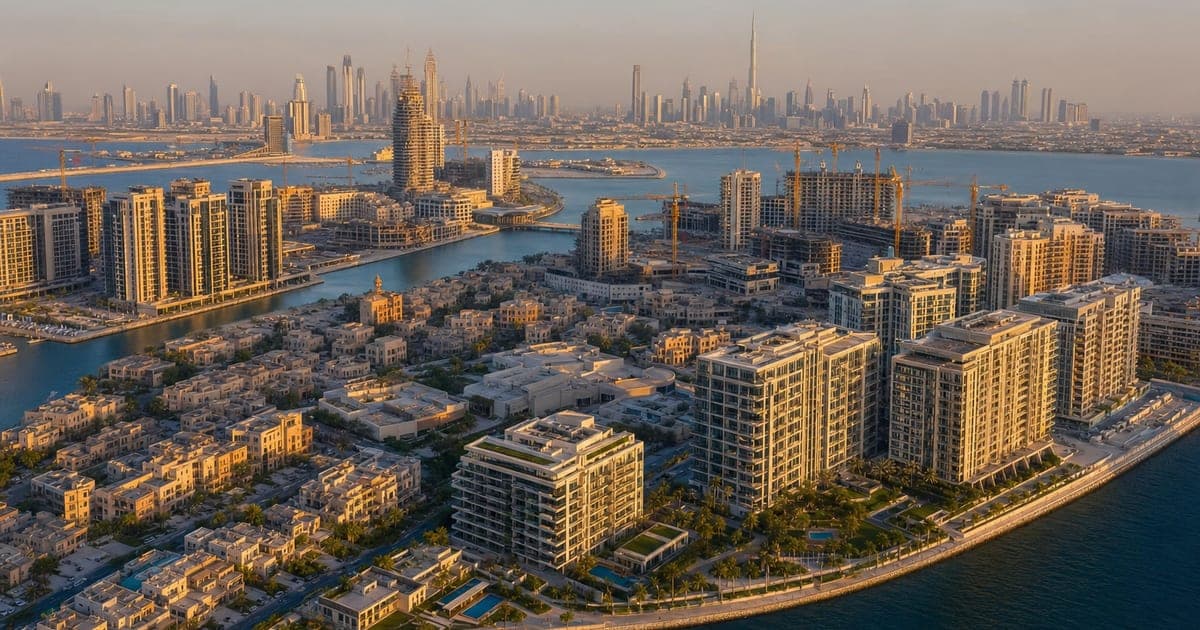
Dubai Islands is a waterfront growth story. Buyers are looking at long-term lifestyle positioning, new supply, hotel and leisure potential, and the possibility of early-stage capital growth. The caveat is that delivery timelines, infrastructure rollout and future competing launches must be checked carefully.
Airport City is tied to Dubai’s long-term expansion around aviation, logistics and the southward growth corridor. This can suit investors who understand masterplan risk and are comfortable with a longer hold period. It is not the same profile as buying a ready apartment in Dubai Marina with established rental evidence.
Business Bay remains one of Dubai’s most liquid mixed-use districts, with strong apartment and office demand. Khaleej Times reported that Dubai’s off-plan office sales reached AED 13.1 billion in H1 2026, with Business Bay generating AED 6.8 billion in off-plan office sales across 476 transactions. That commercial momentum can support residential demand, but investors still need to compare building quality, parking, service charges, views, traffic access and actual rents.
How buyers and investors should act in H2 2026
The market is not giving one universal signal. It is giving different signals by asset type, financing profile and location. Before buying in Dubai in the second half of 2026, use a sharper checklist.
- Check recent DLD comparables: Do not rely only on asking prices. Compare recent completed sales in the same building, project or closest comparable community.
- Stress-test the mortgage: Include bank valuation risk, upfront fees, service charges, maintenance, vacancy and a realistic rent assumption.
- Separate off-plan value from payment-plan comfort: A flexible payment plan helps cash flow, but it does not guarantee resale liquidity or rental demand at handover.
- Watch handover clusters: If several similar projects complete in the same area at the same time, rents and resale prices may face pressure.
- Prioritise end-user depth: Communities with schools, metro access, employment hubs, parks, retail and established daily-life infrastructure usually hold demand better than purely investor-led locations.
- Negotiate harder on ready homes: If sales volume is slower in a building or district, buyers with mortgage pre-approval or cash certainty may have more leverage.
For landlords, the message is similar. The first-half numbers show Dubai remains active, but tenants are increasingly value-conscious. If your unit is in a high-supply apartment market, pricing too far above signed rental evidence may lead to longer vacancy. If your property is a well-managed villa, townhouse or prime apartment with limited comparable supply, the story may be stronger.
The bottom line for Dubai property decisions
Dubai’s H1 2026 property market is not a simple boom-or-bust story. It is a high-volume market entering a more selective phase. Transaction value remains significant, off-plan remains powerful, commercial demand is strengthening in key districts, and mortgages are playing a larger role. At the same time, slower sales volume and a larger launch pipeline mean buyers need discipline.
If you are buying to live in Dubai, focus on lifestyle fit, commute, school access, service charges and long-term affordability. If you are investing, focus on rentability, future supply, exit liquidity and whether the price is supported by actual transactions rather than marketing momentum.
BrokeryHero’s view is straightforward: 2026 can still offer strong Dubai real estate opportunities, but the easy phase of buying anything and expecting the market to do the work is fading. The better move now is to buy with data, local context and a clear hold strategy.
Sources
- It achieved sales of more than 286 billion. 421 billion dirhams in Dubai real estate transactions in the first half of 2026
- Dubai’s real estate transactions surge 31% to reach AED 252 billion in Q1 2026
- Real Estate Transactions
- UAE Real Estate Market Review Q1 2026
- Dubai off-plan office sales hit Dh13.1bn in H1, surpass previous seven years combined
Stay in the loop
Get the latest articles delivered every week.
By subscribing, you agree to receive blog updates. Unsubscribe anytime.
More from this category
Aug 3, 2026
Jul 31, 2026
Jul 22, 2026
Jul 17, 2026
Jul 15, 2026
Jul 13, 2026

Jul 10, 2026
Jul 8, 2026
Jul 6, 2026