Investment Guide
Dubai Industrial Real Estate Is Heating Up: What Warehouse Demand Means for Investors
Florian
•August 12, 2026
Dubai real estate conversations usually start with villas, branded residences and off-plan apartments. But one of the clearest signals in mid-2026 is coming from a less glamorous part of the market: warehouses, logistics parks and industrial districts.
In late July 2026, JLL reported that Dubai industrial rents increased 6.8% year on year and 2.3% quarter on quarter in Q2 2026, supported by healthy occupier demand even as rental growth moderated. CBRE’s Q2 2026 UAE market review also described industrial and logistics property as a standout performer, while Dubai’s residential market was moderating and new supply was easing some pricing pressure.
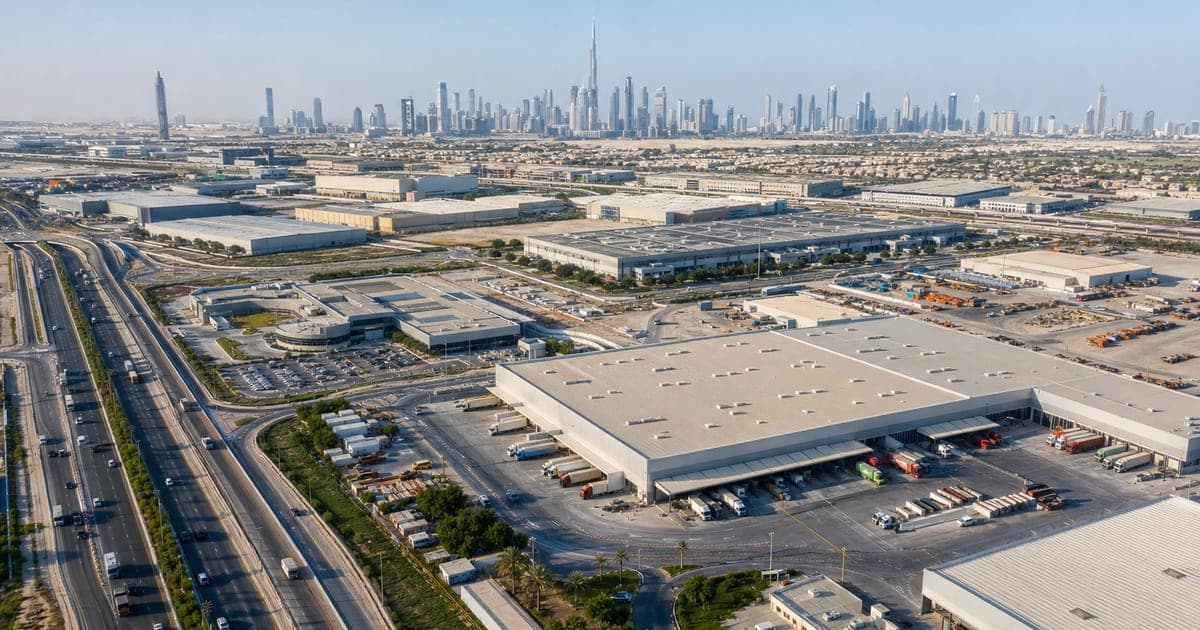
For investors, landlords and buyers relocating to Dubai, this matters. Industrial demand does not only affect warehouse owners. It also shapes employment zones, commuter patterns, staff accommodation demand, residential communities near logistics corridors, and the investment case for areas such as Dubai Industrial City, Dubai Investments Park, National Industries Park, Jebel Ali and Dubai South.
Why Dubai Industrial Real Estate Is Back in Focus
The current story is not just that warehouse rents are rising. The bigger point is that industrial property is benefiting from structural demand at a time when parts of the residential market are becoming more selective.
JLL’s Q2 2026 industrial market note points to constrained Grade A supply, strong occupancy and healthy occupier demand. It also notes that landlords are maintaining asking rates while offering some flexibility on lease terms and selective rental concessions in specific areas. That combination is important: it suggests demand is still present, but tenants are becoming more price-aware and quality-sensitive.
CBRE’s Q2 2026 review adds useful context. It says the UAE real estate market remained durable despite a tougher macro backdrop, with office and industrial markets sustaining growth because of limited supply and occupier demand. By contrast, Dubai’s residential market moderated during the quarter as demand softened, transaction activity declined and new housing supply helped ease pricing pressure.
That does not mean industrial assets are risk-free or that residential investors should ignore apartments and villas. It means the strongest 2026 investment questions are becoming more specific: Which asset class has real occupier demand? Which locations have transport connectivity? Which buildings or plots can serve businesses that need cold chain, e-commerce, food distribution, manufacturing or last-mile delivery?
The July 2026 Signal: New Logistics Investment in Dubai Industrial City
A timely example is Talal Group’s new Central Distribution Centre at Dubai Industrial City, announced on 21 July 2026. The project represents an AED 150 million investment and is planned as an integrated logistics hub with 350,000 sq. ft. of built-up area. According to Dubai Industrial City, the facility will include 25,000 sq. ft. of cold chain storage, 43 loading bays and an e-commerce operations centre, with completion targeted for Q3 2027.
This is exactly the type of occupier that explains why industrial property is gaining attention. It is not speculative office demand. It is an operating business consolidating logistics, retail and corporate functions in one location. It also links directly to food supply chains, cold storage and regional distribution.
Dubai Industrial City’s location is central to the story. The district is positioned near Jebel Ali Port and Al Maktoum International Airport, and it is home to an Etihad Rail freight terminal. For occupiers, that means access to port, air and rail logistics. For property investors, it means industrial demand is tied to infrastructure that is difficult to replicate in scattered, less connected locations.
Another recent example is Al Bayader International’s AED 180 million manufacturing and logistics hub at National Industries Park, announced in June 2026. The project is planned across more than 678,000 sq. ft. and will include manufacturing and logistics space, a robotics-enabled fulfilment centre, headquarters and employee accommodation. These are not small fit-outs; they are long-term commitments to Dubai’s manufacturing and supply chain ecosystem.
What This Means for Residential Buyers Near Logistics Corridors
Most BrokeryHero readers are not buying an entire warehouse. Many are comparing apartments, townhouses and villas in Dubai for end use or investment. So the practical question is simple: how does industrial growth affect residential decisions?
First, logistics and manufacturing hubs create employment density. That can support rental demand in communities within a realistic commute, especially for professionals, supervisors, SME owners, operations managers and families who want value outside central Dubai. Dubai Investments Park, Dubai South, Jebel Ali Village, Expo City surroundings, Remraam, Town Square and parts of Dubailand may all benefit differently depending on commute routes, unit quality and available amenities.
Second, not all proximity is positive. A residential building beside a noisy road, heavy vehicle route or underdeveloped industrial edge may struggle compared with a better-planned community ten minutes farther away. Buyers should not blindly chase the nearest apartment to an industrial zone. They should study access, road movement, schools, retail, noise, building maintenance and future supply.
Third, industrial demand can support staff accommodation and mid-market rentals, but it does not automatically lift every residential project. A premium villa buyer in Dubai Hills Estate and a logistics employee renting near DIP are responding to different drivers. The smart investor separates the demand pool before choosing a unit.
Areas to Watch in Dubai’s Industrial Property Cycle
Dubai’s industrial real estate opportunity is not one single location. It is a network of hubs with different roles. For investors and business owners, the following areas deserve close attention:
- Dubai Industrial City: Strong for manufacturing, logistics and larger occupiers that need scale, multimodal connectivity and access to Jebel Ali Port, Al Maktoum International Airport and Etihad Rail freight infrastructure.
- Dubai Investments Park: A mature mixed-use industrial and residential district with warehousing, staff accommodation, factories, offices and nearby communities. It is relevant for both commercial leasing and residential rental demand.
- National Industries Park: Closely linked to DP World’s trade ecosystem and positioned for manufacturing, logistics and value-added industrial activity.
- Jebel Ali and JAFZA surroundings: A core trade and logistics corridor where port connectivity remains a major advantage for importers, exporters and regional distribution operators.
- Dubai South: A broader growth corridor tied to aviation, logistics, Expo City proximity and the long-term Al Maktoum International Airport story. Investors should be selective because supply can vary sharply by sub-community and developer.
Investor Checklist Before Buying or Leasing a Warehouse
Industrial property is specialist real estate. It can produce attractive income, but only when the asset fits real business requirements. A warehouse that looks cheap on price per square foot may be expensive if it lacks power capacity, loading access, ceiling height, fire safety compliance or the right licensing environment.
Before committing to Dubai industrial real estate, review the following:
- Tenant use case: Is the likely tenant in storage, cold chain, e-commerce, light manufacturing, food distribution, automotive, construction materials or general trading?
- Power and technical specs: Check load capacity, floor loading, clear height, cooling requirements, loading bays, sprinkler systems and civil defence compliance.
- Access: Study truck movement, highway links, port and airport connectivity, and whether heavy vehicles can operate efficiently.
- Lease structure: Understand lease length, rent escalation, fit-out responsibility, maintenance obligations and whether incentives are being used to close deals.
- Free zone or mainland rules: Business licensing, customs, ownership structure and permitted activity can affect tenant demand.
- Exit liquidity: Warehouses can be less liquid than apartments. Know who the future buyer is likely to be before you buy.
Caveats: Do Not Treat Every Industrial Asset as a Safe Bet
The 2026 data is encouraging, but investors should stay disciplined. JLL’s note makes clear that rental growth has moderated, even while demand remains healthy. It also mentions selective concessions in some areas, which means landlords may need to negotiate rather than assume automatic increases.
Another caveat is asset quality. Grade A supply is constrained, but older stock with poor access, weak specifications or deferred maintenance may not benefit equally. Industrial tenants are operational buyers; they care less about brochure language and more about whether trucks can load, inventory can move, staff can commute and compliance is straightforward.
For residential investors, the caveat is oversimplification. A logistics boom can support nearby housing demand, but only when the community offers livability. Schools, supermarkets, clinics, traffic patterns and building management still matter. In Dubai, a good location is not just a pin on a map; it is the daily experience of getting in, out and around.
Conclusion: Follow Real Demand, Not Just Hype
Dubai industrial real estate is one of the most useful market signals of 2026 because it is tied to operating businesses, supply chains and long-term infrastructure. The recent Talal Group and Al Bayader investments show that companies are still committing capital to Dubai’s logistics and manufacturing ecosystem, while JLL and CBRE data point to continued rental growth and resilience in industrial hubs.
For investors, the opportunity is not simply to buy anything near a warehouse district. It is to understand where business demand is real, where infrastructure is improving, and where residential communities can benefit from employment-led growth without taking on unnecessary location risk.
BrokeryHero helps buyers and investors read these signals practically: not as hype, but as a way to compare Dubai property options with better questions and clearer due diligence.
Sources
- UAE Industrial Market Dynamics, Q2 2026 - JLL
- UAE Real Estate Market Review Q2 2026 - CBRE UAE
- Talal Group breaks ground on AED 150 million Central Distribution Centre at Dubai Industrial City
- Al Bayader International invests AED 180 million in food packaging hub at National Industries Park
- Mohammed bin Rashid approves decisions to enhance industrial resilience, support national products
Stay in the loop
Get the latest articles delivered every week.
By subscribing, you agree to receive blog updates. Unsubscribe anytime.
More from this category
Sep 9, 2026
Sep 7, 2026
Sep 4, 2026
Sep 2, 2026
Aug 31, 2026
Aug 28, 2026
Aug 17, 2026

Aug 14, 2026
Aug 10, 2026