
Market Analysis & Updates
Dubai Off-Plan Launches Just Shifted Mid-Market: What May 2026 Data Means for Buyers
Florian
•June 8, 2026
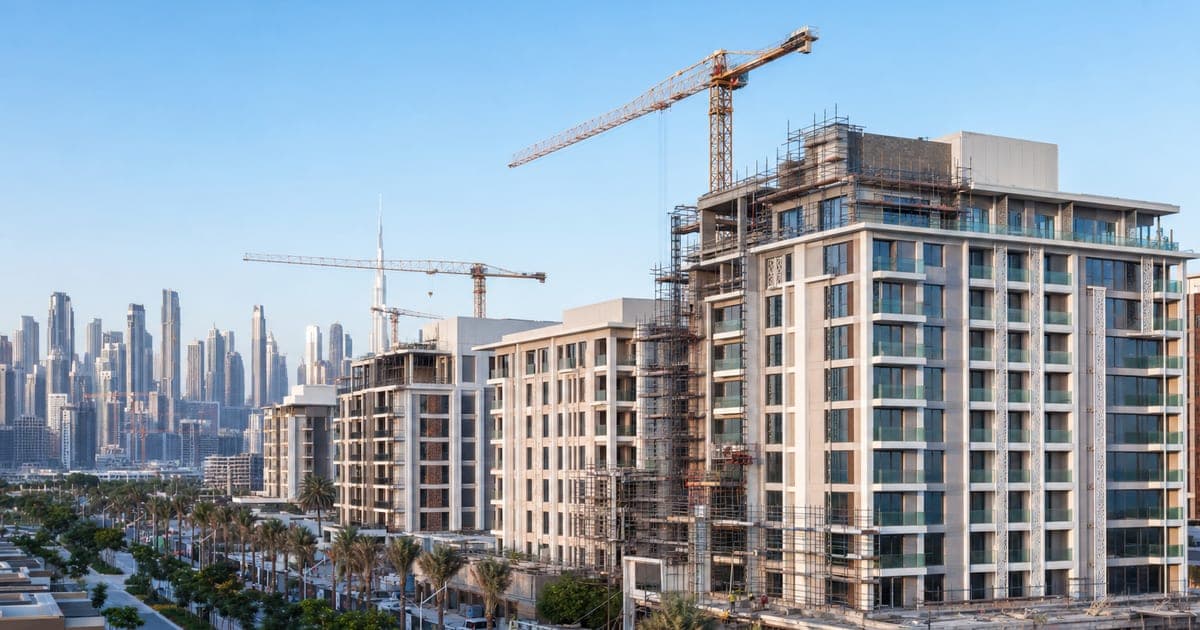
Dubai off-plan buyers have had a lot of noise to filter in 2026: record transaction headlines, softer rental chatter, new visa conversations, and a constant stream of project launches. The latest REIDIN Residential Project Launch Tracker for May 2026 gives a clearer signal: developers are leaning hard into the mid-market apartment buyer.
That matters because launch mix often tells us where developers believe demand is deepest. In May 2026, Dubai recorded 14 residential project launches, totaling 2,942 units across 12 developers. The average launch price was AED 1,657 per sq.ft, with project pricing ranging from AED 1,158 to AED 2,642 per sq.ft. Most importantly, 86.4% of launched units sat in the AED 1,200 to AED 1,800 per sq.ft bracket.
For buyers and investors, this is not just another monthly data point. It is a practical clue about affordability, competition, rental targeting, and where the off-plan market may be trying to find its next layer of demand.
What changed in Dubai off-plan launches in May 2026?
May was materially different from April. REIDIN reported that April 2026 saw 8 residential launches totaling 1,465 units, with an average launch price of AED 1,968 per sq.ft. In May, launch activity rose to 14 projects and 2,942 units, while average pricing moved lower to AED 1,657 per sq.ft.
That combination is important. More units plus a lower average launch price suggests developers are not only chasing ultra-prime headline demand. They are creating inventory that speaks to salaried end users, first-time investors, and yield-focused buyers who want Dubai exposure without committing to luxury-ticket waterfront stock.
The asset split also tells a story. May launches included 2,721 apartments and 221 villa units. In other words, this was overwhelmingly an apartment-led launch month. The dominant payment plan shown in REIDIN’s tracker was 50/50, and the report also identifies a typical broker commission of 5%.
That does not mean every buyer should rush into the next new launch. It means buyers should compare new off-plan pricing against ready-property alternatives in the same corridor, especially where handovers, service charges, metro access, and tenant demand can vary building by building.
Why the mid-market shift matters for Dubai buyers
The strongest data point from May is the concentration in the mid-market band. REIDIN’s tracker shows 86.4% of launched units priced between AED 1,200 and AED 1,800 per sq.ft, while 4.1% fell below AED 1,200 per sq.ft and 9.5% sat in the AED 1,800 to AED 3,000 per sq.ft upper-mid bracket. No luxury or ultra-luxury launches were recorded in May by REIDIN’s pricing segmentation.
This has three practical implications for Dubai property buyers.
- More choice at accessible price points: Investors who were priced out of prime areas may find more realistic ticket sizes in communities such as Downtown Jebel Ali, Arjan, Dubai Production City, City of Arabia and JVC.
- More competition between developers: When many projects are aimed at the same buyer profile, payment plans, handover timelines, floor-plan efficiency and developer track record become more important than marketing claims.
- More need to check resale depth: Mid-market does not automatically mean liquid. A well-priced apartment in a connected, rentable area can be very different from a similar-looking unit in a thin resale pocket.
The broader market context supports this more selective approach. Dubai Land Department reported AED 252 billion in real estate transactions in Q1 2026, up 31% year-on-year by value, while foreign investment value reached AED 148.35 billion, up 26%. CBRE’s Q1 2026 review also showed more than 45,000 residential sales transactions in Dubai, with off-plan properties accounting for more than 32,600 transactions and AED 103 billion in value. The demand base is still large, but it is becoming more disciplined.
Neighborhoods to watch: Downtown Jebel Ali, Arjan, JVC and more
The May launch concentration was not spread evenly across Dubai. REIDIN reported that the Downtown Jebel Ali project represented 924 units, or 31.4% of May launched inventory. The top five communities, Downtown Jebel Ali, Arjan, Dubai Production City, City of Arabia and JVC, accounted for 68% of launched units.
For investors, these locations need different underwriting assumptions.
Downtown Jebel Ali may appeal to buyers looking at long-term growth linked to the wider Jebel Ali, Expo City, Dubai South and logistics corridor. The key question is not only launch price, but future livability: walkability, retail delivery, public transport access, handover phasing and how quickly the tenant base matures.
Arjan continues to attract apartment launches because it sits between established family areas, leisure destinations and major road links. Buyers should compare new-build pricing against completed buildings nearby and pay attention to parking ratios, building management and realistic rental demand for studios and one-bedroom units.
JVC remains one of Dubai’s most liquid mid-market apartment communities, but that also means buyers must be careful. With many buildings and developers in the same district, not every unit has the same resale profile. Layout efficiency, views, service charges, developer quality and walking access to retail can make a major difference.
Dubai Production City and City of Arabia can offer more affordable entry points, but investors should be conservative on exit timing. These areas may work well for long-hold buyers if the purchase price is sensible and the building is genuinely attractive to tenants.
How investors should read the off-plan numbers
A mid-market launch wave is not automatically a bargain wave. The right question is not whether Dubai off-plan is hot. The right question is whether a specific unit gives you enough margin for construction risk, payment-plan obligations and future competition from other handovers.
CBRE’s Q1 2026 review described Dubai residential performance as a market balancing itself after very strong activity in January and February, with March showing quieter volumes. Cavendish Maxwell data reported by Zawya also pointed to 66,900 residential sales from January to May 2026, with off-plan purchases accounting for around 74% of transactions, while May sales activity softened compared with April and with May 2025.
That mix is useful for investors. Dubai is still attracting capital, but buyers are no longer in a market where every off-plan reservation should be treated as easy money. In a more selective phase, your edge comes from underwriting.
Before reserving a Dubai off-plan apartment in 2026, check:
- Comparable ready prices: If the new launch is priced above completed stock nearby, you need a strong reason, such as better quality, payment terms or location.
- Payment plan pressure: A 50/50 plan can be attractive, but only if your cash flow can handle construction-stage payments and handover costs.
- Developer delivery history: Look beyond the brochure. Ask how similar projects were delivered, managed and received by tenants.
- Unit efficiency: A smaller, well-planned one-bedroom can rent and resell better than a larger but awkward layout.
- Future supply: If several nearby projects complete around the same time, assume tenants will have options and price your rent expectations accordingly.
- Exit plan: Decide upfront whether this is a rental hold, a post-handover resale, or a lifestyle purchase. Each requires a different unit choice.
What end users should do before buying off-plan
End users often approach off-plan differently from investors. They are buying a future home, not just a yield calculation. But the same discipline applies.
If you are buying to live in Dubai, focus first on daily life. A lower price per sq.ft is not useful if the commute is painful, the school run is unrealistic, or the community will not be ready when you move in. For families, apartment launches in JVC, Arjan or Downtown Jebel Ali should be compared with ready townhouses or older apartments in more established areas. The cheaper purchase may not always be the better living decision.
Also be careful with handover assumptions. Expected completion dates can move, and the cost of renting while waiting for handover should be part of your budget. If your purchase is linked to relocation, schooling or a planned move from renting to owning, build in a time cushion rather than relying on the most optimistic delivery date.
The BrokeryHero view: opportunity is moving, but selectivity matters
The May 2026 launch data points to a Dubai off-plan market that is still active, but increasingly focused on attainable price bands and apartment-heavy communities. That is a healthy development for buyers who felt locked out by luxury pricing, but it also increases the need to separate strong projects from lookalike inventory.
For investors, the opportunity is in well-located, efficiently planned units with credible delivery, sensible service-charge expectations and real tenant demand. For end users, the best purchase is not always the newest launch or the lowest entry price. It is the property that fits your commute, lifestyle, cash flow and exit options.
BrokeryHero helps buyers read Dubai property data with a practical lens: what is launching, what is actually worth comparing, and what risks should be priced in before you sign. In a mid-market off-plan wave, good advice is not about chasing every launch. It is about choosing the right one for the right reason.
Sources
- Dubai Residential Project Launch Tracker – May 2026
- Dubai Residential Project Launch Tracker - May 2026 PDF
- Dubai’s real estate transactions surge 31% to reach AED 252 billion in Q1 2026
- UAE Real Estate Market Review Q1 2026
- Dubai residential property sector secures almost 67,000 sales from January to May 2026 – Cavendish Maxwell
Stay in the loop
Get the latest articles delivered every week.
By subscribing, you agree to receive blog updates. Unsubscribe anytime.
More from this category
Oct 19, 2026
Oct 14, 2026

Oct 12, 2026
Oct 9, 2026
Oct 7, 2026
Oct 5, 2026

Oct 2, 2026

Sep 30, 2026

Sep 28, 2026

Sep 25, 2026